
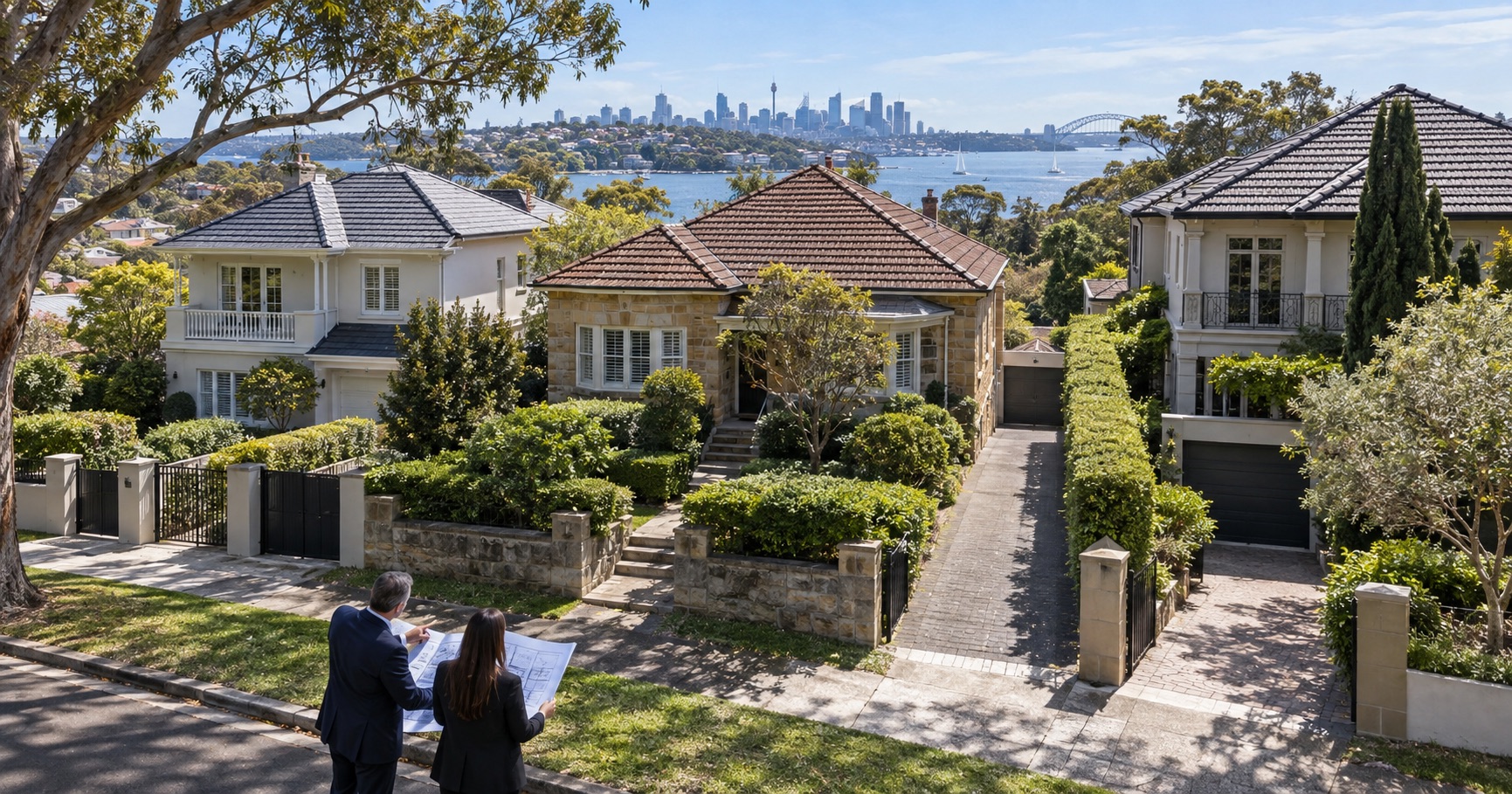
Woollahra homeowners combine sites ahead of density rezoning
A 2,200-square-metre residential holding in Sydney’s Woollahra is being offered to developers after three neighbouring homeowners combined their properties, providing an early test of how proposed higher-density planning controls could affect land values and development opportunities in the eastern suburbs.
The Wallaroy Road holding comprises three adjoining five-bedroom homes. Property records cited in the report identify two of the owners as Universal Australia commercial vice president Alisa Lai and Perpetual’s outgoing deputy head of equities Anthony Aboud.
No formal price guide has been released, although industry sources estimate the combined site could attract as much as $50 million.
Aboud paid about $18 million for his property two years ago, while Lai purchased her home for $6.5 million in 2023. Property records show the third residence last changed hands for $6.55 million in 2018.
Rezoning could materially increase development capacity
Under the proposed planning controls, the amalgamated site could accommodate a 22-storey building containing as many as 50 residences if the changes proceed in their current form.
The owners are already seeking greater development potential, applying to the NSW Government for controls that could allow a larger building accommodating 100 or more residences.
The broader Edgecliff-Woollahra rezoning proposal is intended to facilitate approximately 9,400 new homes, with buildings reaching up to 34 storeys around Edgecliff and 32 storeys around Woollahra. The proposal remains in draft form.
Raine & Horne Double Bay agent Alex Lyons, who is managing the campaign, said the owners were responding to the government’s planning direction but that uncertainty remained over when the new controls would be finalised.
The state also plans to charge developers $15,000 per dwelling to help fund a new train station on the eastern suburbs line, which is planned to open in 2029.
Development feasibility remains a key constraint
Additional density does not necessarily mean every potential site will become viable.
Chaim Lieder, co-founder of Sydney development-site advisory business Lieder Property, said demand from developers had slowed significantly as the housing market weakened and the industry confronted higher construction costs and tighter lending conditions.
Lieder said his business was speaking with about 20 developers a week and that many were currently taking a cautious approach to acquiring sites.
He also said some properties remained difficult to make commercially feasible even after allowing for higher development capacity under the proposed planning changes.
That uncertainty is particularly important for owners considering site amalgamation. Greater permissible density can increase the potential number of dwellings, but developers still have to assess construction costs, financing and the price they can justify paying for the land.
Council proposes lower housing target
Woollahra Council has raised concerns about the NSW Government’s proposed controls and has put forward an alternative plan providing for about 3,600 additional dwellings instead of 9,400.
The state proposal remains subject to its planning process, with the NSW Government saying the draft rezoning is designed to increase housing supply around Edgecliff and the future Woollahra station.
Despite the uncertainty, Lyons said the Wallaroy Road campaign had already attracted interest from both local and international developers.
For property investors and landowners, the campaign illustrates how rezoning can change the potential use of adjoining residential properties. It also highlights the distinction between additional planning capacity and a project that developers can ultimately finance and deliver.
SOURCE ATTRIBUTION:
Based on reporting by Sarah Petty. Source publication.