
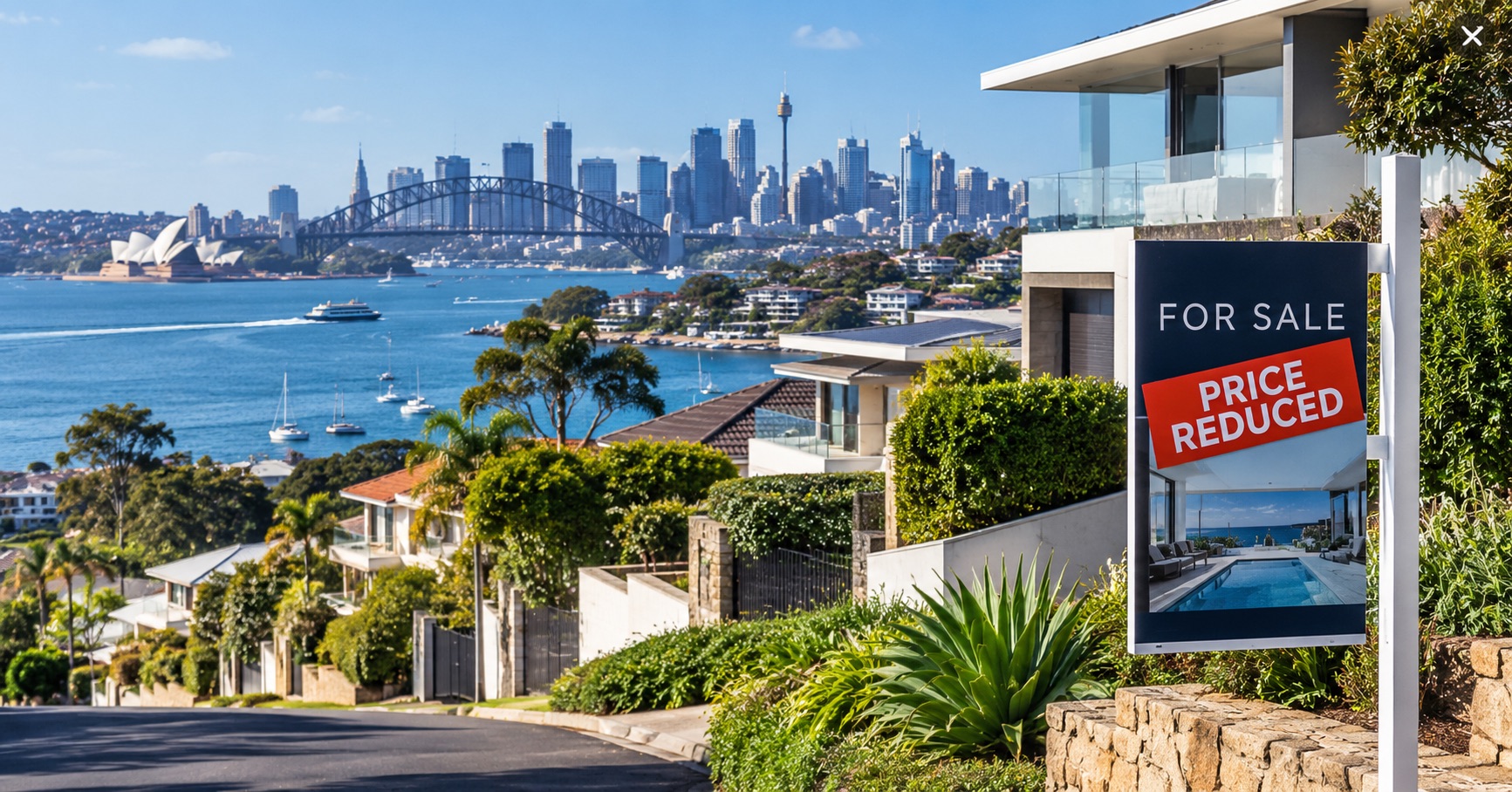
Prestige property downturn deepens in Sydney and Melbourne
National home values are about 2 per cent below their March peak, but the downturn is not being felt evenly. Cotality data prepared for The Australian Financial Review shows the largest declines are concentrated in Sydney and Melbourne, particularly in higher-priced suburbs.
North Curl Curl on Sydney’s northern beaches recorded the steepest fall in the data, with median dwelling values down 19.4 per cent from a September 2025 peak of $4.1 million to $3.3 million in July. Malabar fell 18.7 per cent, while Wheeler Heights and Point Piper were down about 17 per cent.
Every suburb in the top 50 for price declines from its post-January 2025 peak was located in Sydney or Melbourne.
Prestige markets lead the decline
The weakness at the upper end is also evident across broader market segments. Over the past three months, values for Sydney’s most expensive 25 per cent of properties fell 5.2 per cent, compared with 1.4 per cent for the least expensive quartile.
In Melbourne, the top quartile declined 4.6 per cent, versus 1.2 per cent for the cheapest quartile.
Mosman’s median value has fallen 13 per cent from its June 2025 peak of $2.6 million to $2.2 million in July. In Melbourne, Toorak values have dropped 12 per cent since April 2025 to $1.3 million.
Other large declines in Cotality’s top-10 table included South Coogee, down 15.6 per cent; Chifley, down 15.4 per cent; Melbourne’s Deepdene, down 14.1 per cent; Elanora Heights, down 13.2 per cent; Little Bay, down 13.1 per cent; and North Wahroonga, down 12.9 per cent.
Housing weakness feeds into rate expectations
The housing correction is also shaping expectations for monetary policy. The report says three Reserve Bank interest rate rises since the start of the year have affected buyer confidence, while changes to negative gearing and the capital gains tax discount in the May budget have also weighed on sentiment.
Economists cited in the report expect the RBA to keep the cash rate at 4.35 per cent when it meets on Monday and Tuesday, with some arguing that weaker property conditions could reduce the need for another increase.
Morgan Stanley expects national house prices could fall by as much as 10 per cent, potentially producing the largest housing correction in 40 years. NAB forecasts a 10 per cent peak-to-trough fall in Sydney and Melbourne.
RBC macro rates strategist Robert Thompson said weaker housing would point to a softer economic and inflation outlook. The report notes that about 60 to 70 per cent of Australians’ net household wealth is tied to property, meaning falling values could reduce household spending.
Lower-priced homes have held up better, but the weakness is broadening. Commonwealth Bank senior economist Trent Saunders said affordability constraints and first-home buyer support were likely helping demand at the lower end.
Even so, lower-tier values fell in Sydney, Melbourne, Brisbane and Canberra in July, as well as across the combined capital-city index.
For property investors, the figures show an uneven downturn by location and price segment, with the largest falls still concentrated at the top end while declines begin to extend further down the market.
SOURCE ATTRIBUTION:
Based on reporting by The Australian Financial Review.