
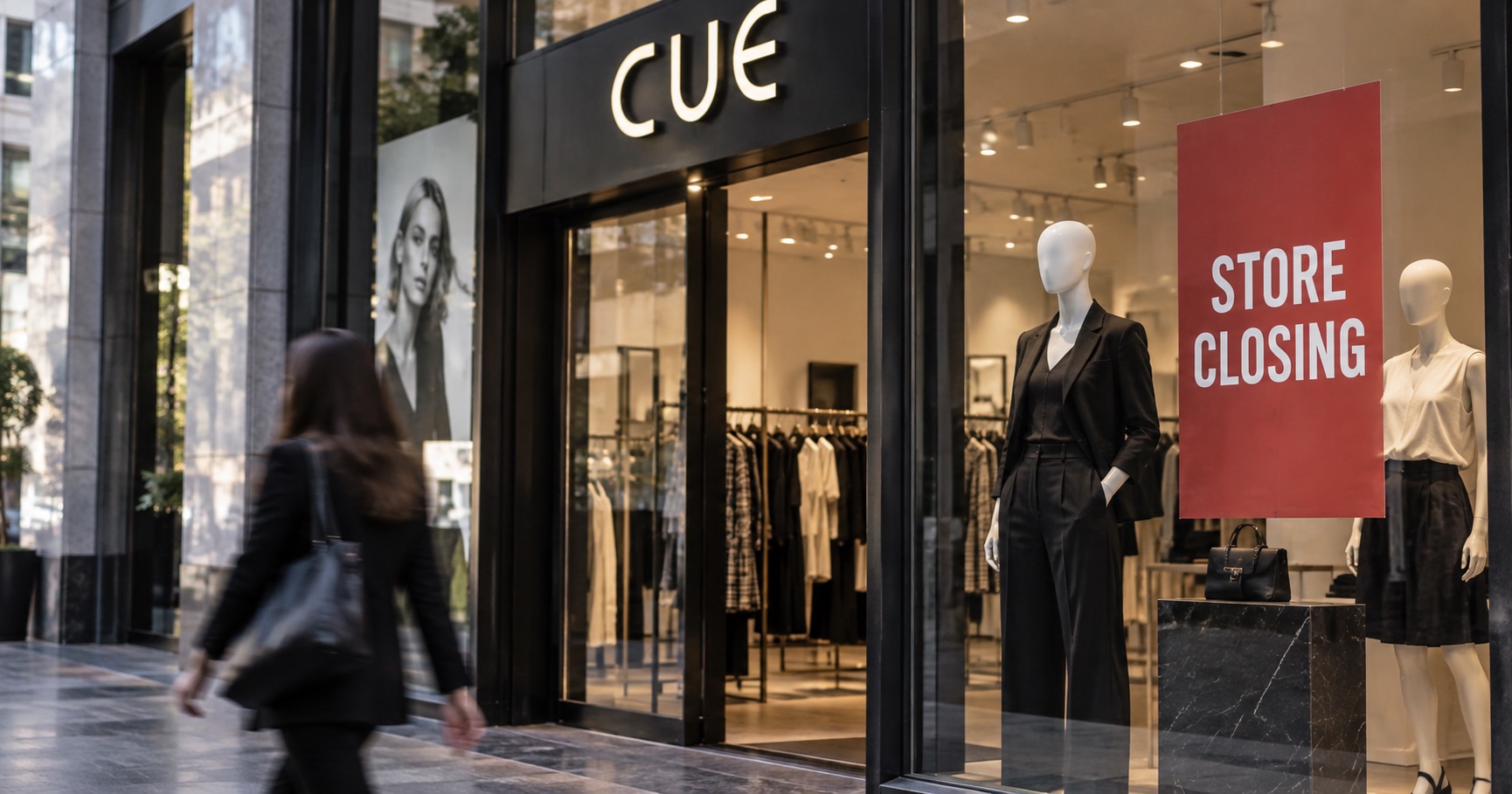
Cue collapse highlights pressure on Australian fashion retail
Cue Clothing’s collapse has put renewed attention on the pressures facing established Australian fashion retailers, as intensifying competition, changing shopping habits and financial strain reshape the sector.
The retailer, founded by Rod Levis in 1968, once operated more than 230 stores across Australia and New Zealand, alongside concessions in Myer and David Jones. By the time Cue and sister brand Veronika Maine entered administration, the network had contracted to 51 stores plus a small number of concessions.
FTI Consulting, acting as receiver, said at least five stores would close.
Competition erodes a long-standing retail position
Cue built its early reputation around workwear for women entering the workforce and later promoted its Australian-made credentials, manufacturing locally until 2023 despite higher labour and related costs.
Retail consultant Trent Rigby said the company’s original point of difference had become harder to defend as more brands moved into workwear and consumers gained access to a much wider range of retailers.
Jane Lu, founder and chief executive of online retailer Showpo, said Australian fashion had become increasingly difficult for brands seeking to stand out as consumers became more selective and trends moved faster.
Australian Fashion Council chair Marianne Perkovic also pointed to the effect of lower-cost international retailers such as Shein and Temu on domestic operators.
The competitive pressure extended across traditional and online retail. The report cited Country Road, Witchery, Saba, Dissh and online operators as part of the crowded market Cue faced, while broader cost-of-living pressure was making consumers more cautious.
Other Australian fashion businesses have experienced similar difficulties. Tigerlily has entered administration twice in six years, while Myer announced earlier this year that it would close Sass & Bide, which it acquired in 2013, before eventually relaunching the label.
Sale process fails despite improving sales
Cue’s financial position had shown some signs of improvement before the collapse. Sales reached $103.2 million in the latest financial year, up from $98 million, while losses narrowed to $5.1 million.
FTI had previously told prospective buyers that sales were forecast to rise to nearly $130 million this year, with margins also expected to improve.
However, Hilco, a British financier specialising in distressed assets, had acquired Cue from the founding Levis family last year and subsequently sought a buyer. The process attracted interest from Larry Kestelman’s Brand Collective and Will Vicars’ Oroton, but no transaction was completed and Hilco withdrew financial support.
The report also said the business had been destabilised by an ongoing lawsuit involving founder Rod Levis and his son Justin Levis, Cue’s former executive director, over succession plans.
Cue had attempted to refresh its profile over the years, using models including Claudia Schiffer, Catherine McNeil and Jessica Hart in campaigns. In 2011, it partnered with designer Dion Lee on a capsule collection and later invested in his business. Dion Lee entered administration in 2024 and was eventually sold to US online fashion retailer Revolve.
For retail property owners and investors, Cue’s contraction provides a reminder that established tenants can face rapid pressure when sales competition, financing constraints and changing consumer behaviour converge. Its fall from more than 230 stores to administration also illustrates how quickly a once-established retail footprint can shrink when a turnaround fails to secure new capital or a buyer.
SOURCE ATTRIBUTION:
Based on reporting by The Australian Financial Review, published 21 September 2026. Source: www.afr.com